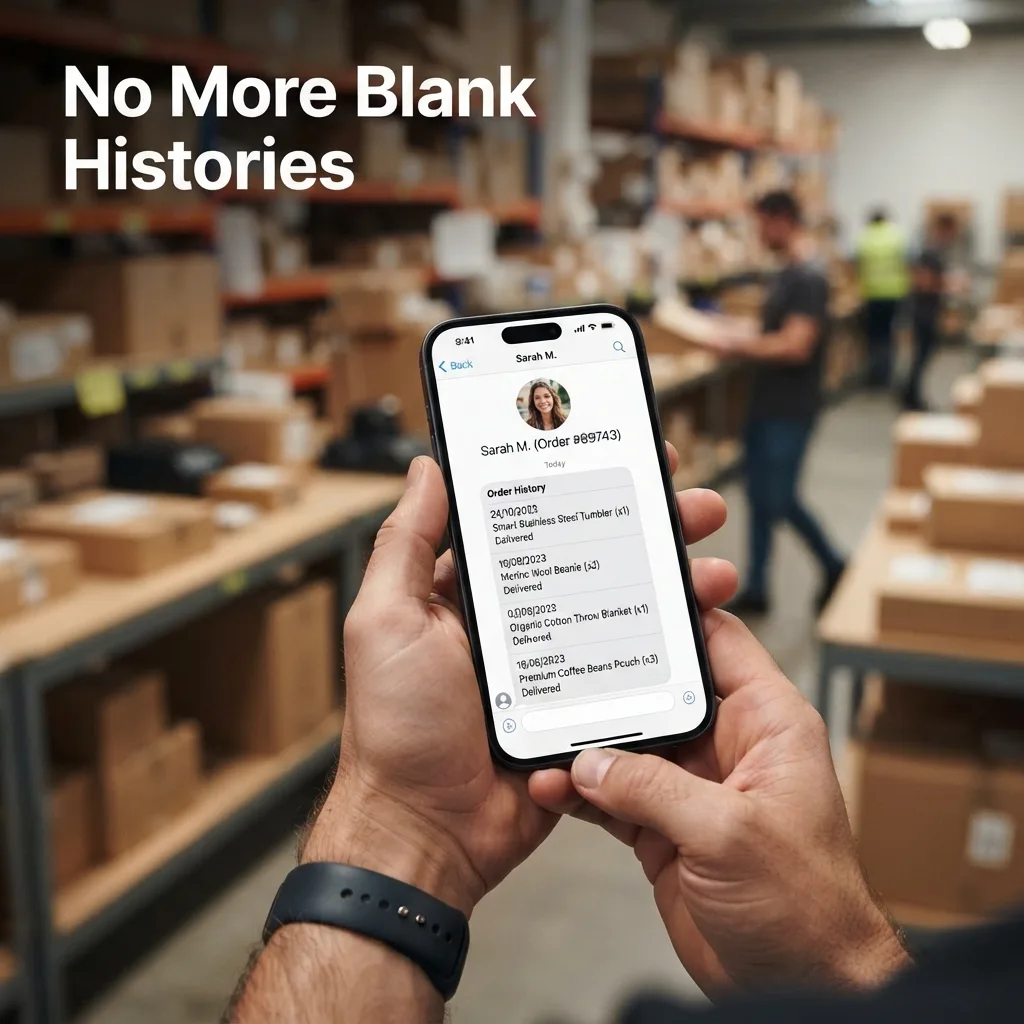
Repeat buyers leave when they have to explain their preferences, address, and past orders every single time they message you. To stop losing repeat buyers to a blank history, you must unify your chat logs into a persistent customer record that tracks every transaction across all messaging platforms.
The mechanism behind the blank history
Most chat-based businesses rely on the native memory of apps like WhatsApp or Messenger. While these apps save messages, they do not organize data. A customer is simply a phone number or a profile picture. The history is a chronological stream of text, not a structured database of preferences.
When a customer returns after three months, the seller must scroll through hundreds of messages to find the last order. If the customer switches from Facebook Messenger to WhatsApp, the history is completely severed. The seller sees a new contact and treats a loyal customer like a first-time stranger because the identity is tied to the platform, not the person.
The operational cost of forgetting
Treating a repeat buyer like a stranger creates immediate friction that kills conversion rates. When a customer has to re-type their delivery address or remind you that they prefer a specific size, they feel the burden of your disorganized backend. This friction makes the buying process feel like work.
Beyond the customer experience, the internal cost is measured in wasted time. Sellers spend hours each week performing manual searches through chat scrolls to verify past payments or shipping details. This manual retrieval is a bottleneck that prevents a small team from scaling. You cannot handle a thousand orders a day if every single one requires a five-minute archaeological dig through a chat history to find a customer's zip code.
Practical steps to build a persistent record
Moving away from a blank history requires shifting your data from the chat app to a centralized system. You can implement this transition using these steps:
• Centralize identity. Map every incoming message to a unique identifier, such as a phone number or email, regardless of whether it comes from WhatsApp, Messenger, or a website chat. • Extract order data. Instead of leaving order details inside a message bubble, move the size, color, quantity, and total price into a structured customer profile immediately after the sale. • Tag customer preferences. Use tags to mark high-value buyers or specific product interests. If a customer frequently buys a specific category, that attribute should be visible the moment their chat opens. • Archive shipping details. Store the delivery address in a dedicated field. The goal is to reach a state where you can ask, "Same address as last time?" instead of "Where should I send this?"
Measuring the impact of customer memory
You can tell your record-keeping is working by monitoring two specific signals. First, track the time from the first message of a repeat buyer to the completed checkout. In a blank-history environment, this is long because of the data-gathering phase. With a persistent record, this window shrinks significantly.
Second, monitor your repeat purchase rate. When customers feel recognized and the friction of ordering is removed, they are more likely to return. A rise in the percentage of orders coming from existing contacts indicates that your system is successfully removing the barriers to purchase.
When a full history is not required
This approach is essential for businesses with repeat-purchase products, such as clothing, cosmetics, or consumables. However, if you sell one-time high-ticket items—like a specialized piece of machinery or a luxury home installation—the overhead of maintaining a deep CRM may not be necessary. In those cases, a simple transaction log suffices because the customer is unlikely to return for a second purchase within a reasonable timeframe.
OrderPilot provides an AI order desk and CRM that automatically turns every chat into a permanent customer record with full order history. By automating the transition from conversation to data, you ensure no loyal customer ever feels like a stranger.