Banglish messages are easy to misread because spelling and shorthand vary from buyer to buyer. Reply in the customer's own style and confirm every order in plain words before it ships. Most of the guessing disappears once those two habits are in place.
Why Banglish messages are easy to misread
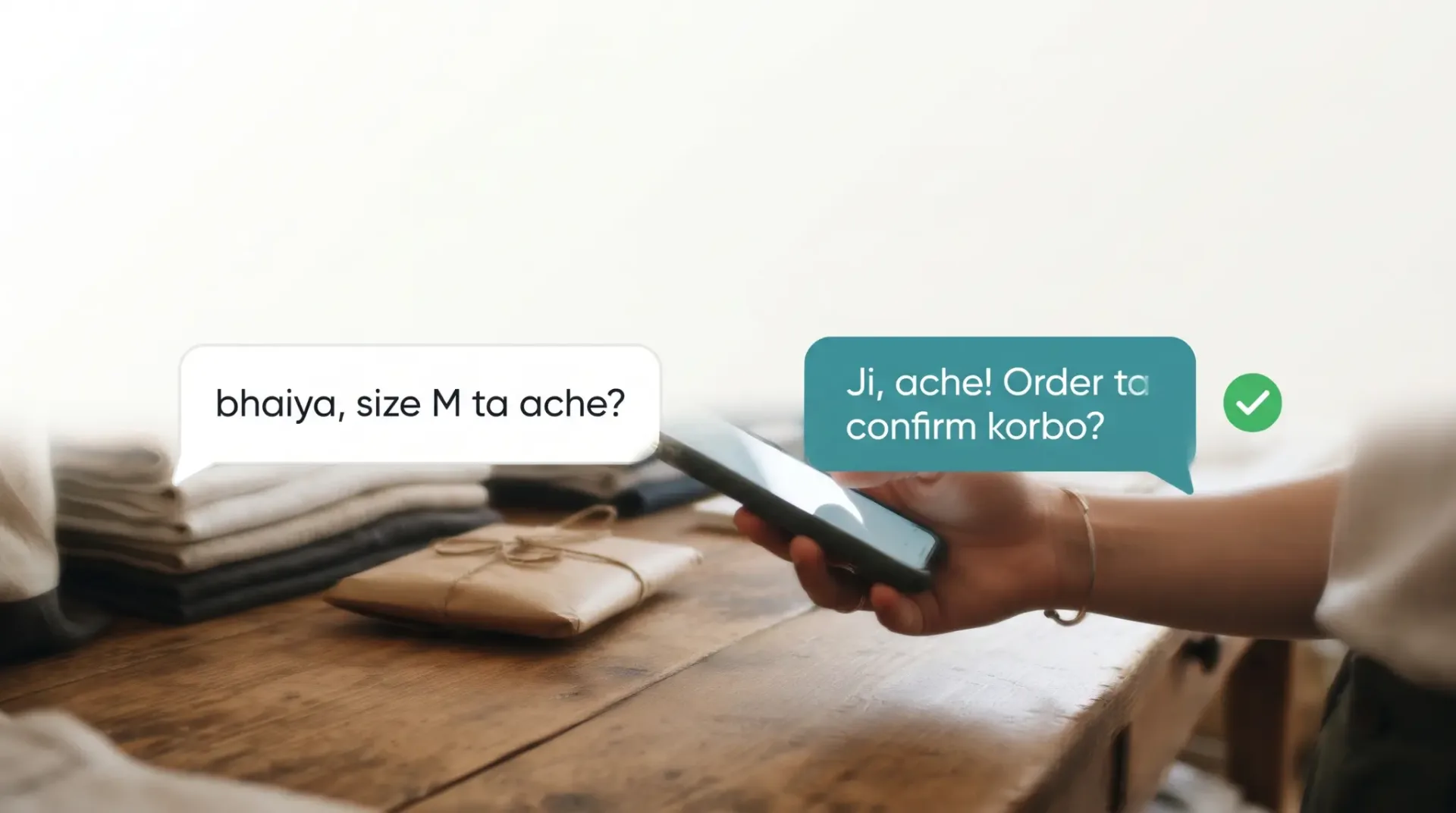
Buyers write the way they talk, switching between Bangla, English, and Bangla typed in Roman letters, sometimes inside a single line. A message like "bhaiya, size M ta ache? kal pabo?" is clear to someone who knows the shop, but it packs a stock question and a delivery question into a few words.
Two things make this hard. First, Banglish has no fixed spelling, so the same word shows up in several forms and you cannot search or match it reliably. Second, the messages are short and carry several questions or details at once, so a quick read tends to answer one and skip the other.
Neither cause means your customers are unclear. They are writing naturally, and the shop needs a method that copes with natural writing.
What a misread message costs
A reply that arrives late, or answers only half the question, usually costs you the sale. The buyer asked because they were ready to buy, and a confusing answer sends them to the next seller. Unanswered and half-answered chats are a large part of how orders disappear, and lost orders in chat: why they happen and how to stop them covers that problem in more detail.
A misread detail is a second cost. If "M ta" is read as the wrong variant, or a quantity is taken from the wrong part of the message, the order is wrong from the start, and you find out only when the buyer complains.
Fix 1: Reply in the customer's own style
Match the language the buyer used. If they wrote in Banglish, answer in Banglish. If they wrote full English, answer in English. A stiff, formal reply to a casual message slows the conversation, and a casual reply to a formal buyer can feel careless.
Matching the style does not mean copying spelling mistakes. Use clear, simple words, keep the reply short, and answer every question the message asked. If a message contained a stock question and a delivery question, the reply should contain both answers.
Fix 2: Keep a phrase list for the questions that repeat
Write down the questions you get every day in the ways buyers actually phrase them: "stock e ache?" for availability, "dam koto?" for price, "delivery charge koto?" for delivery, and "COD hobe?" for cash on delivery. Next to each one, write the answer you want to give, taken from your product catalog, including price, variants, and delivery charge.
The list keeps your answers consistent, and it makes replies fast because you are choosing rather than composing. It also becomes the source for anyone else who replies for you. If an AI assistant answers on your behalf, it works from the same material, because an AI sales assistant reads your catalog rather than learning your shop from examples. Train an AI sales assistant on your product catalog covers how to prepare product records, rules, and tests so it answers correctly.
Fix 3: Confirm the order in plain words
When the buyer agrees to order, repeat the details back with each one spelled out, even if the chat has been casual. For example: "Blue t-shirt, size M, quantity 1, delivery to the address above. Order ta confirm korbo?"
This one message does the work that spelling cannot. The buyer sees exactly what you understood and can fix a wrong size or quantity before anything ships. It also leaves a written record of what was agreed, so you are not rebuilding the order later from a scrolling chat.
Do not guess when a detail is vague. A reply of just "ok" or "hobe" may agree to the order or only acknowledge your message, so ask for a clear yes to the confirmed details.
Fix 4: Ask, or hand off, when you are unsure
If you cannot tell what the buyer means, ask one short question instead of guessing. "Apni kon color ta nite chacchen?" costs the buyer a few seconds and saves a wrong parcel.
Some chats are not about wording at all. Complaints, payment disputes, and anything sensitive should reach a person, not a template or an assistant. The same rule applies if an AI is replying for you: it can draft the order while you keep the decision, and some conversations should always come to you first. Can you trust an AI to take orders in chat? walks through which ones.
How to tell it's working
Three signals are worth watching:
- Buyers confirm the order summary without corrections more often than before.
- You spend less time asking the same clarifying question in different chats.
- Anyone who replies for you gives the same answer to the same question.
OrderPilot's AI sales assistant works in Bangla, English, and Banglish and drafts each order for you to confirm.
When this doesn't apply
If nearly all your buyers write clear, full sentences in one language, you will not need much of this, and a phrase list may be more than the shop requires. The confirmation message still pays off for every order, because it catches mistakes that have nothing to do with language.