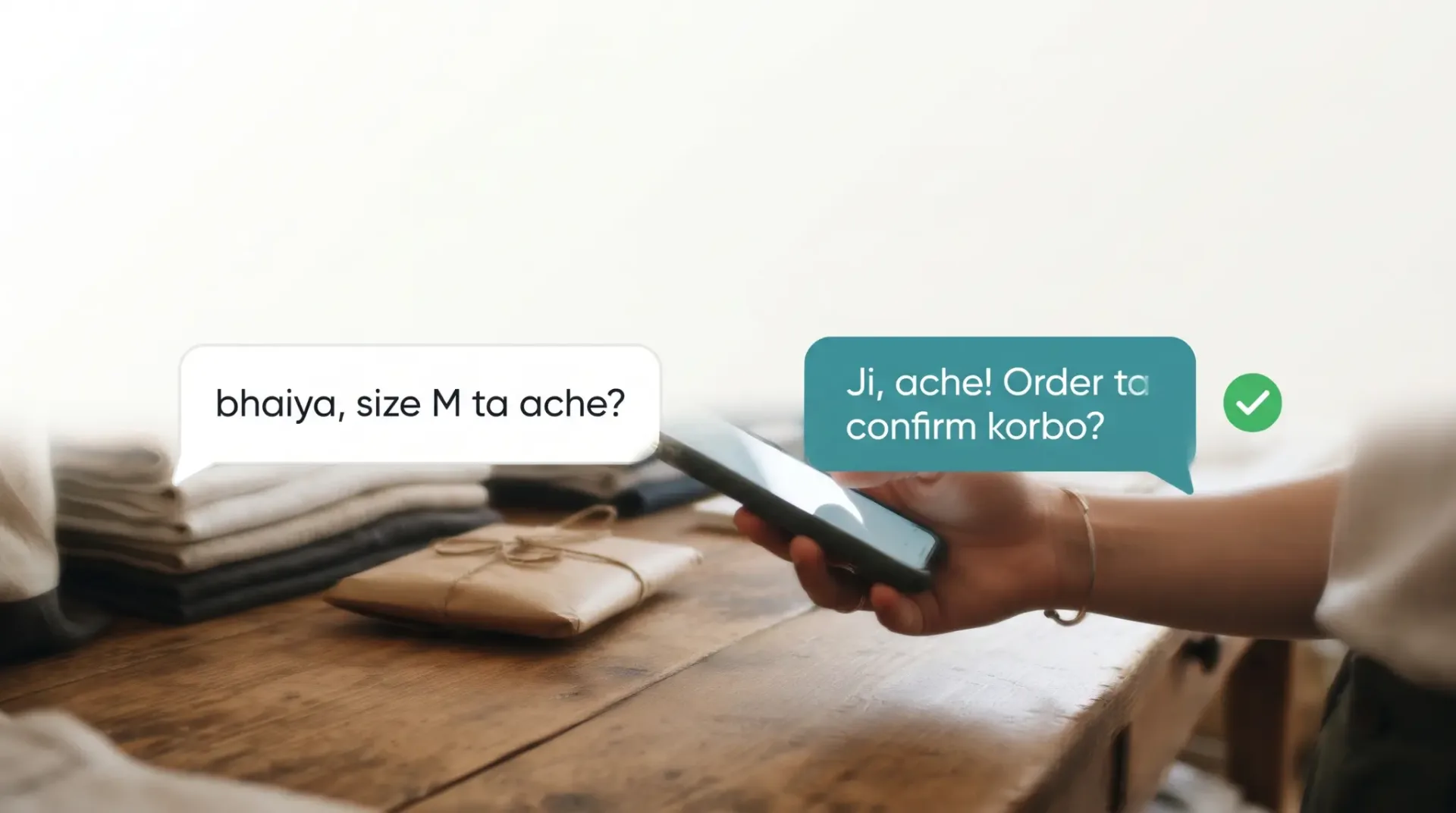
Facebook shop response time often decides who gets the sale. A buyer who asks about stock and delivery charge and then waits may message the next shop instead. The fix is a fast, correct first reply that does not depend on how busy your team is.
You lost to whoever answered first
Picture a buyer who finds a product on your Page and likes it. He messages: is it available, what is the delivery charge, is there any discount? Your team is busy with other orders, so his message sits unanswered.
He is still browsing, and other shops selling something similar are one tap away. He sends one of them the same questions. That shop answers within minutes, and he orders there. When your reply finally goes out, he tells you he has already bought it elsewhere.
This is an illustration, not a case study, but most chat sellers will recognise it. The buyer did not leave over your product or your price. An answer reached him somewhere else first.
Why the inbox is the checkout in Bangladesh
The e-Commerce Association of Bangladesh estimates that there are 200,000 to 250,000 active Facebook commerce page entrepreneurs, according to BSS in March 2026. A recent report on Pathao Commerce describes how a typical sale runs for these sellers: a product goes up on a Page, a buyer messages to ask about size and price, the seller checks availability and confirms, and a courier is booked.
That sequence has no checkout page. The reply does the job a product page would do elsewhere, so the first clear answer carries a lot of weight. With this many similar Pages competing for the same buyers, the wait between question and answer matters.
The three questions that cannot wait
Messages like the one above are common in chat selling, and each question carries a risk if it is answered late or vaguely.
- Is it available? A buyer who asks this is close to ordering. The answer has to match your real stock.
- What is the delivery charge? The e-Commerce Association of Bangladesh has reported that a significant share of customer complaints relate to unclear delivery costs, according to Dhaka Tribune. A clear charge in the first reply removes one source of that trouble.
- Is there any discount? Whether the answer is yes or no, the buyer needs it before deciding.
What the research says about reply speed
The studies below cover B2B sales teams and global shoppers, not Bangladeshi Facebook shops, so treat them as a rough guide.
A Twilio consumer survey found that 51% of consumers expect a reply from a business within an hour, and that 86% are more likely to complete a purchase if they can message a brand in real time. A widely cited Harvard Business Review study of B2B sales teams found an average first response time of 42 hours, and teams that replied within five minutes had much better odds of engaging the lead.
Neither proves the first reply always wins. Both show that waiting has a cost.
How Facebook shop response time is measured
Facebook already scores you on this. Meta’s business help says the “Very responsive to messages” badge appears on Pages with a Messenger response rate of 90% or higher and a response time under 15 minutes.
The same guidance lists what does not count toward those numbers. Instant replies and away messages are left out, and so are messages in your Spam and Done folders and messages that arrive while your Page is set to away. In practice that means an automatic “we will reply soon” does not count as a reply, so a real answer is what moves the number. It also means that moving finished chats to Done and junk to Spam keeps your numbers honest.
Fast is not enough: the answer has to be right
A CM.com survey of 7,078 people found that 7 in 10 consumers prefer a good answer over a direct response. In chat selling, a quick “yes, available” that turns out to be wrong creates a bigger problem than a short wait would have.
So the speed you build has to rest on accurate records: the right price, the right sizes and colors, and real stock. If you plan to let an AI assistant answer for you, those records are what it reads, and Train an AI sales assistant on your product catalog shows how to prepare them.
How to reply faster without hiring anyone
These are habits you can start this week.
- Write the three answers once. Save one standard reply for stock checks, one for delivery charges by area, and one for your discount rule, so whoever is on shift sends the same words.
- Fix check-in times for busy days. Reply to Messenger customers faster when life gets busy covers a routine built on saved replies and fixed check-in times.
- Give each order one place to live the moment a buyer says yes. How to stop losing orders in WhatsApp and Messenger explains how.
- Decide which chats must always reach you, such as angry customers or refund demands, before you automate any first replies. Can you trust an AI to take orders in chat? is a solo seller’s guide to draft orders and the chats that should reach you first.
OrderPilot is built for the first reply: it answers in Bangla, English or Banglish from your real products and prices, and you confirm every order.
How to tell it is working
Message your own Page from a personal account once at a quiet hour and once at a busy one, and note how long a useful answer takes. A useful answer covers stock, delivery charge and discount. A greeting alone does not count.
Over time, the “Very responsive to messages” badge appearing on your Page is a second signal, since it only shows when your response rate and response time meet Meta’s thresholds.
If your replies are already quick and buyers still drop off, look at price and trust in your Page first. Faster replies will not fix those.